Air conditioning service in Dallas, Texas

AC Companies in Dallas

Get clear recommendations for repair, replacement, or routine maintenance based on your equipment, comfort concerns, and property.

✓Residential AC service ✓Commercial cooling support ✓Repair and replacement options
Air conditioning technician inspecting an outdoor condenser at a Dallas home on a clear summer day

A Dallas Air Conditioning Company for Homes and Businesses

People comparing AC companies in Dallas usually need more than a quick sales pitch. They need a company that can identify the cause of weak cooling, explain whether a repair makes financial sense, and provide a written scope before work begins. Bold HVAC Dallas handles air conditioning repair, installation, replacement, and preventive maintenance for residential and commercial properties.

We are a professional HVAC service company in Dallas, TX that evaluates the complete cooling system rather than treating every symptom as an isolated equipment failure. That means checking thermostat operation, airflow, filters, electrical components, condensate drainage, refrigerant-side performance, and the condition of the indoor and outdoor units. If replacement is being considered, the recommendation should also account for duct condition, return-air capacity, equipment sizing, efficiency ratings, and the building's electrical requirements.

Dallas heat puts long operating hours on cooling equipment. Attics can become extremely hot, clogged outdoor coils reject heat poorly, and restricted airflow can cause comfort problems even when the condenser still runs. A useful diagnosis separates maintenance issues, installation defects, control problems, duct losses, and failed components before recommending a course of action.

Complete cooling support

What Air Conditioning Companies in Dallas, Texas Should Offer

AC Repair and Diagnostics

A proper service visit starts with the reported symptoms and measured system performance. Depending on the fault, testing may cover the capacitor, contactor, blower motor, compressor circuit, thermostat, temperature split, condensate controls, and refrigerant pressures.

System Installation and Replacement

Replacement involves more than selecting a brand or matching the old unit's nominal tonnage. Equipment should be selected for the building load, paired correctly, installed with sound refrigerant and drainage practices, and commissioned after startup.

Preventive AC Maintenance

Cooling maintenance may include cleaning accessible coils, replacing or inspecting filters, clearing the drain, checking electrical connections, testing controls, and recording operating conditions. Findings should identify urgent defects separately from optional improvements.

Airflow and Duct Evaluation

Hot rooms, excessive noise, short cycling, and weak supply airflow may point to undersized returns, restrictive filters, closed dampers, damaged ducts, or incorrect blower settings. Testing airflow prevents an equipment change from masking a distribution problem.

Commercial Cooling Support

Commercial properties require attention to occupancy, operating schedules, rooftop access, controls, tenant impact, and service coordination. The work plan should identify affected areas and any access or shutdown requirements.

Indoor Comfort Controls

Thermostats, zoning controls, humidity management, filtration, and ventilation can affect comfort as much as the cooling equipment. Recommendations should match the property's existing system rather than assume every accessory is compatible.

Compare the complete scope

How to Compare AC Companies in Dallas

Start by looking for a diagnostic process, not a predetermined recommendation. A credible air conditioning company in Dallas should be willing to show what was tested, identify the failed or underperforming part, and explain how the finding relates to the problem you noticed. For replacement work, ask whether the estimate includes equipment model numbers, efficiency ratings, labor, permits when applicable, disposal, controls, drain work, and startup testing.

Ask how the company determines capacity. Replacing an old system with equipment of the same nominal size is not always the right answer because insulation, windows, additions, duct changes, and earlier sizing errors can affect the load. Manual J is the recognized residential load-calculation method, while Manual S addresses equipment selection and Manual D covers duct design. The scope of calculation needed depends on the project, but the contractor should be able to explain the basis for its recommendation.

Credentials and paperwork matter as well. In Texas, air conditioning and refrigeration contracting is regulated by the Texas Department of Licensing and Regulation. Customers can verify a contractor's license status through the agency. For work within Dallas, permit requirements depend on the job, so ask who will determine whether a permit and inspection are required.

Finally, compare warranties carefully. Separate the manufacturer's parts warranty from the contractor's labor terms, and ask whether product registration is required. A low initial quote may omit drain modifications, electrical corrections, equipment stands, duct transitions, or commissioning tasks that appear in a more complete proposal.

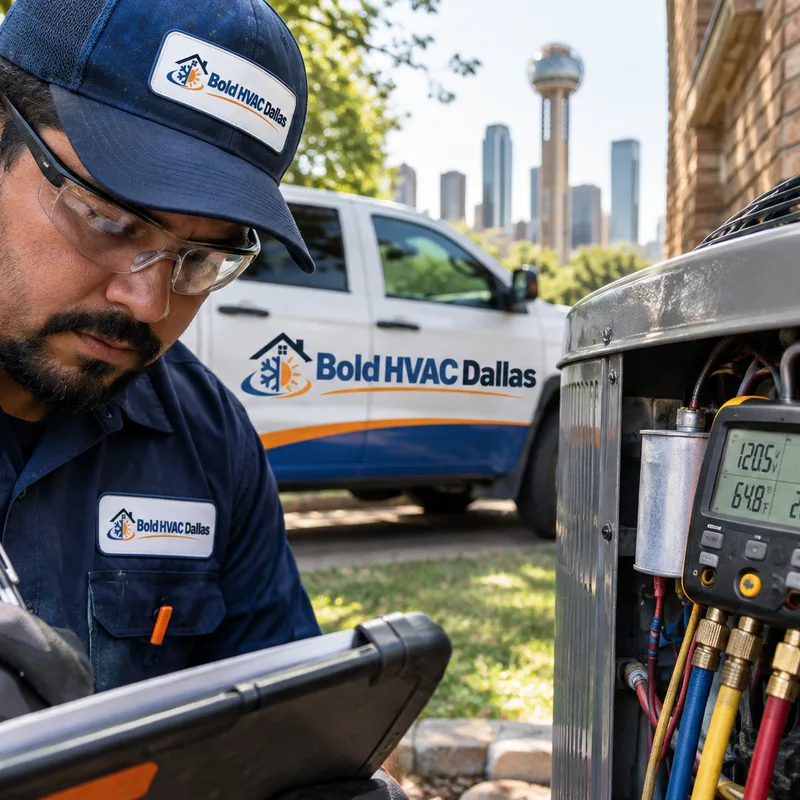
Technician recording electrical and operating measurements beside a residential air conditioning system in Dallas
Measured findings support a clear repair or replacement recommendation.
From symptoms to verification

What to Expect When Working With an Air Conditioning Company in Dallas

Check Availability
01

Describe the Cooling Problem

Share when the issue began, which areas feel uncomfortable, whether the system runs continuously or cycles frequently, and any unusual sounds, odors, leaks, or thermostat messages. These details help guide the initial inspection.

02

Inspect and Test the System

The technician checks relevant components and operating conditions. For a no-cooling visit, that may include the thermostat, disconnects, electrical components, indoor airflow, condensate safety devices, coil condition, and refrigerant-side readings when appropriate.

03

Review the Findings

You should receive a plain explanation of the fault, available repair options, and any conditions that could affect reliability. If replacement is worth considering, repair and replacement should be discussed as separate choices.

04

Approve a Written Scope

The scope should identify the proposed work and major included items. Replacement proposals should state the equipment being installed, efficiency information, warranty terms, and any known duct, drain, electrical, permit, or access work.

05

Complete and Verify the Work

After repair or installation, the system should be operated and checked. Verification may include temperature readings, electrical measurements, thermostat operation, drainage, airflow settings, refrigerant charge procedures, and a review of completed work.

Dallas-specific service planning

Local Cooling Conditions and Property Types

Dallas has hot summers that keep air conditioners working for long periods, so equipment condition and heat rejection matter. Cottonwood debris, grass clippings, and dust can collect on an outdoor coil and reduce airflow through it. Indoor restrictions matter too. A heavily loaded filter or an undersized return can reduce airflow across the evaporator coil and contribute to poor comfort or coil icing.

Property type changes the service approach. Older homes in established areas such as Oak Cliff and Lakewood may have additions, tight mechanical spaces, or duct systems altered over many years. In Uptown, multifamily buildings can involve access rules, shared chases, equipment location constraints, and coordination with building management. Downtown commercial properties may require rooftop access planning and work that limits disruption to occupants. In North Dallas, larger floor plans and multiple systems can make zoning and room-by-room airflow especially relevant.

These conditions should shape the inspection rather than the sales language. The right plan may be a targeted component repair, a drain correction, duct sealing, control work, scheduled maintenance, or full replacement. Good Dallas air conditioning companies explain why the proposed work fits the property and the measured condition of the system.

Air conditioning service vehicle and technician working safely beside outdoor HVAC equipment at a Dallas property
Practical equipment planning

Repair or Replace: Making a Practical Decision

Repair is often reasonable when the fault is isolated, the system has otherwise been dependable, compatible parts are available, and the repair cost is proportionate to the equipment's condition. Examples include certain capacitor, contactor, drain, thermostat, or motor problems. The diagnosis still matters because the same symptom can have different causes.

Replacement deserves consideration when the equipment has repeated failures, a major component has failed, corrosion or coil leakage is present, comfort remains poor despite repairs, or the system uses an older refrigerant that makes future service more difficult. The decision should also account for indoor equipment compatibility. Outdoor and indoor components must form an approved match if the system is being replaced as a complete split system.

Efficiency labels require context. SEER2 is a seasonal efficiency rating used for current residential equipment, but a higher rating alone does not correct poor ductwork, improper sizing, or weak installation practices. Ask the air conditioning company in Dallas, TX, to explain the proposed matched system, expected operating characteristics, electrical needs, and any changes required at the air handler, furnace, drain, thermostat, or duct connections.

Check Availability

Get a diagnosis or replacement scope that explains the proposed work, the equipment involved, and the conditions that can affect final pricing.

Call to Schedule
Helpful answers

Questions to Ask AC Companies in Dallas, TX

How much does AC service cost in Dallas?+

The price depends on whether you need a diagnostic visit, routine maintenance, a specific repair, or equipment replacement. Repair cost is driven by the failed component, system type, parts availability, refrigerant work, access, and related electrical or drainage corrections. Replacement pricing depends on capacity, efficiency, equipment configuration, duct transitions, controls, permits, and installation conditions. A written estimate after inspection is more useful than a generic price because Dallas properties range from detached homes to high-rise commercial spaces.

How quickly can an air conditioning company in Dallas respond?+

Availability depends on current demand, technician schedules, the type of problem, and whether special parts or building access are required. Extreme summer heat can increase service demand across Dallas. When arranging service, describe whether the system is completely off, cooling poorly, leaking water, tripping a breaker, or serving someone especially vulnerable to heat so the company can assess urgency.

Should I repair or replace an older air conditioner?+

Repair usually makes sense when the problem is limited, the system is otherwise serviceable, and the projected cost is reasonable compared with replacement. Replacement becomes more practical when failures are recurring, a compressor or coil has failed, refrigerant availability complicates service, or the system cannot keep the building comfortable. Ask for the diagnosis, repair scope, replacement scope, and warranty terms in writing before deciding.

Do AC replacements in Dallas require a permit?+

Some air conditioning work in Dallas may require permits and inspections, depending on the exact scope. Requirements can involve mechanical, electrical, or related work. The contractor should determine which City of Dallas rules apply, state who is responsible for the permit, and include that responsibility in the proposal.

How should a new air conditioner be sized?+

A new air conditioner should be selected using the building's cooling load and the performance of a properly matched system, not square footage alone. Residential contractors commonly use Manual J principles for load calculations and Manual S for equipment selection. Dallas heat, window exposure, insulation, air leakage, ceiling height, occupancy, and duct condition can all affect the result.

What should be included in an AC replacement estimate?+

An AC replacement estimate should identify the indoor and outdoor equipment, capacity, efficiency rating, labor scope, controls, warranties, disposal, and known accessory work. It should also address duct transitions, condensate drainage, electrical requirements, equipment supports, refrigerant lines, permits when applicable, and startup testing. Ask whether manufacturer registration is included or remains the property owner's responsibility.

How often should air conditioning maintenance be scheduled in Dallas?+

A common approach is to schedule cooling maintenance before or during the cooling season, with filter checks occurring more often according to the filter type, property use, pets, dust load, and manufacturer guidance. Dallas systems can accumulate debris at outdoor coils and operate for extended periods during hot weather. Commercial equipment or systems with heavy runtime may need a maintenance schedule tailored to the property.

Can an AC company fix uneven temperatures between rooms?+

An AC company can diagnose many causes of uneven temperatures, but the right correction depends on testing. Common causes include duct leakage, restricted returns, damaged flex duct, closed dampers, poor register placement, solar gain, insulation gaps, incorrect blower setup, or equipment sizing issues. In larger North Dallas homes and altered older homes, a room-by-room airflow review may be more useful than replacing equipment without checking distribution.

Plan the next step

Need a Clear Plan for Your Air Conditioning System?

Tell Bold HVAC Dallas what the system is doing and what type of property it serves. Our team can assess the equipment, explain the findings, and outline the next practical step.