Little or No Cooling
We check thermostat calls, electrical power, contactors, capacitors, compressors, condenser fans, evaporator airflow, and refrigerant circuit conditions. The visible symptom is only the starting point.
Serving Dallas, Texas & surrounding areas
24/7 Emergency Response
Fast troubleshooting and practical repairs that help protect employee comfort, customer experience, equipment, and daily operations.
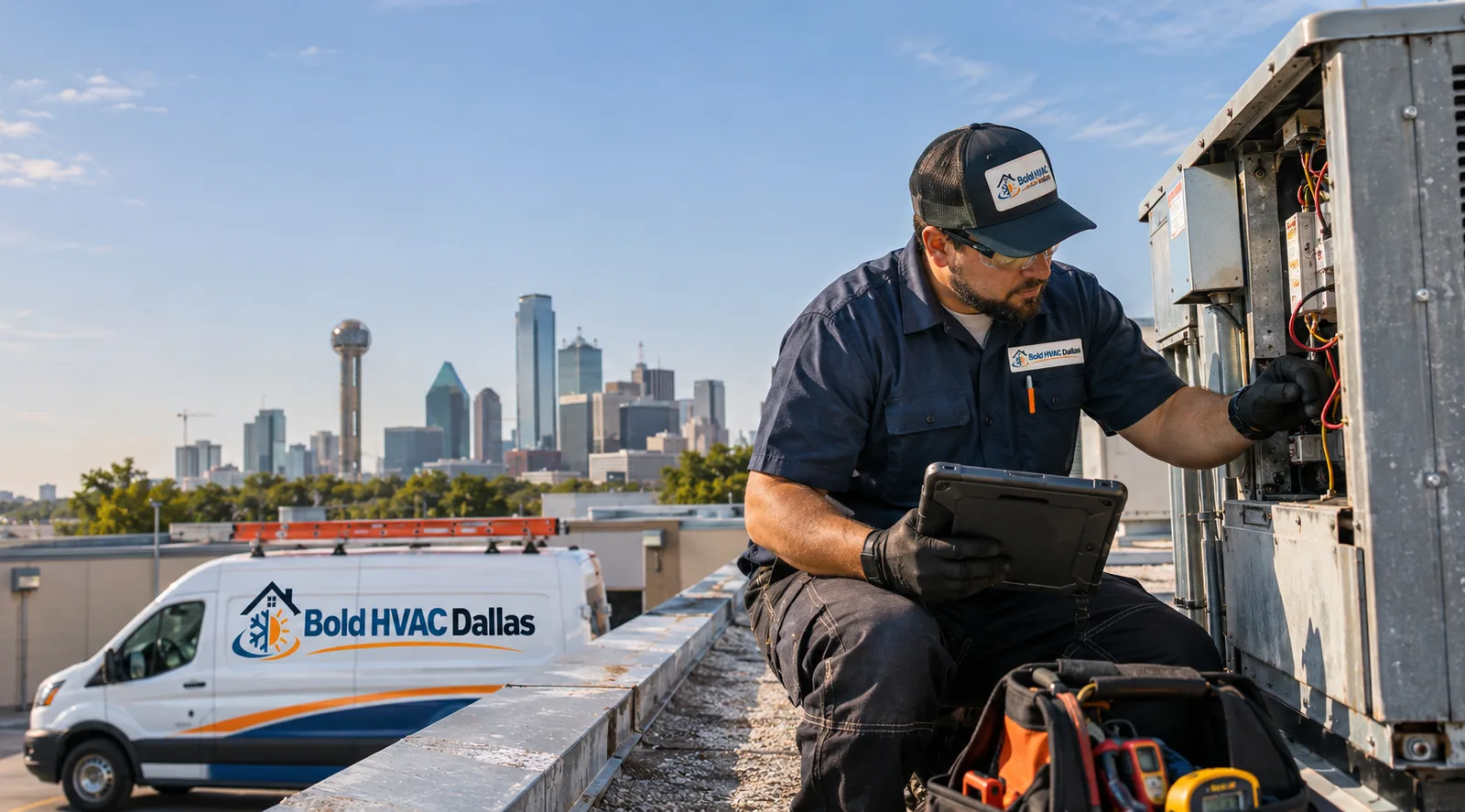
When cooling or heating fails at a business, the repair affects more than room temperature. Employees may struggle to work, customers may leave, and temperature-sensitive equipment or inventory can be put at risk. Bold HVAC Dallas provides commercial HVAC repair Dallas businesses can use to identify the fault, understand the options, and make an informed repair decision.
We troubleshoot rooftop packaged units, split systems, heat pumps, commercial furnaces, air handlers, and common control problems. The first goal is to determine whether the failure comes from electrical controls, airflow, refrigeration, drainage, combustion equipment, or the building thermostat. That diagnosis matters because similar symptoms can have very different causes. A frozen evaporator coil, for example, may result from low airflow, a dirty coil, or a refrigerant-side problem.
As an HVAC service company around Dallas, we approach the work with the needs of an operating business in mind, including access, tenant communication, work areas, and the effect of downtime. You receive a clear explanation of the finding and the recommended repair before authorized work begins.
We check thermostat calls, electrical power, contactors, capacitors, compressors, condenser fans, evaporator airflow, and refrigerant circuit conditions. The visible symptom is only the starting point.
Hot offices and overcooled rooms can point to damper issues, duct leakage, blocked returns, control problems, poor airflow, or equipment that is not operating through its full sequence.
Packaged rooftop units combine major heating, cooling, and airflow components in one cabinet. Repairs may involve motors, belts, ignition parts, sensors, controls, coils, or condensate components.
Weak airflow, high humidity, odors, or excessive dust may require inspection of filters, blower assemblies, belts, coils, drains, duct connections, and outside-air components.
For gas-fired equipment, diagnosis may include the ignition sequence, flame sensing, safeties, gas controls, venting, and heat exchanger condition. Unsafe operation should never be bypassed.
Failed sensors, loose wiring, incorrect schedules, control board faults, and communication errors can stop otherwise serviceable equipment from responding correctly.
Extended hot weather puts commercial cooling equipment under sustained demand. Condenser coils must reject heat outdoors, while compressors, fan motors, electrical connections, and capacitors operate through long cycles. Dirt on a condenser coil, restricted airflow, or a weakening electrical component may become much more apparent during high outdoor temperatures.
The repair plan also depends on the property. Downtown Dallas buildings may require coordinated roof access, loading arrangements, or communication with property management. Deep Ellum restaurants and entertainment venues can have dense internal heat loads and business hours that complicate service timing. The Design District includes showrooms, studios, warehouses, and mixed commercial spaces where equipment type and access differ from one property to the next. In Uptown, tenant comfort complaints may involve multi-zone controls rather than a complete equipment shutdown.
Oncor delivers electricity across much of the Dallas area, but an apparent HVAC failure still requires equipment-level testing. A technician can distinguish a building power issue from a tripped disconnect, failed contactor, open safety, control fault, or damaged motor circuit.
We ask when the problem began, which areas are affected, whether it is intermittent, and whether anyone changed schedules, controls, filters, or electrical equipment. This helps narrow the test sequence.
The technician checks equipment condition, power, disconnects, obvious damage, filters, belts, coils, drains, and accessible wiring. Gas-fired equipment receives checks appropriate to its heating sequence and safety controls.
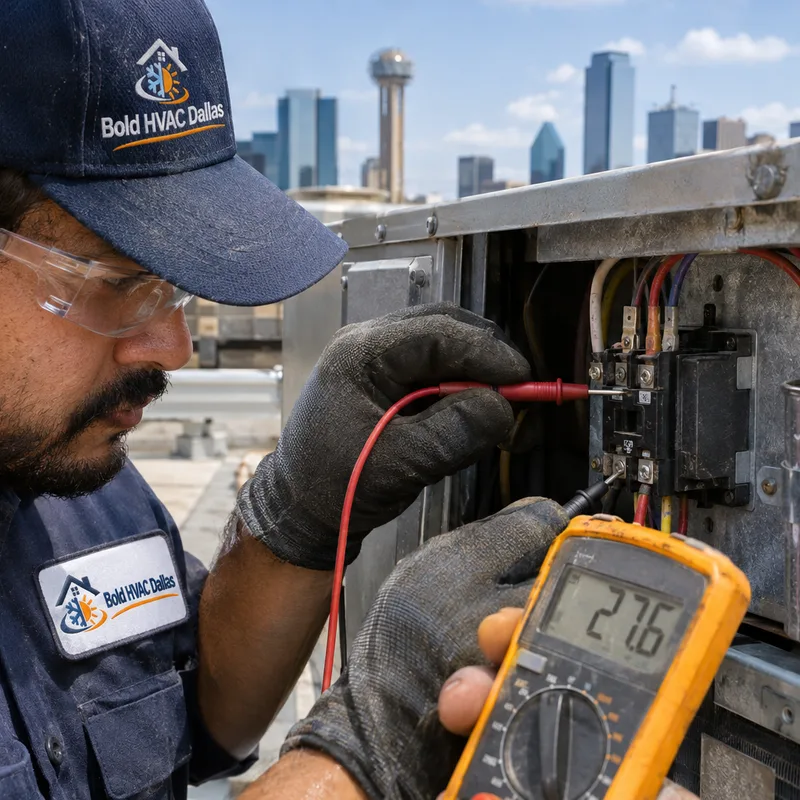
Measurements may include voltage, amperage, capacitance, temperature split, static pressure, control signals, and refrigerant pressures when those readings are relevant. Parts should not be replaced solely because a symptom resembles a common failure.
You receive the diagnosis, proposed scope, and any known limitations. If a part must be sourced or broader work is advisable, we explain how that affects timing and operation.
After approval, the repair is performed and the equipment is tested through an operating cycle. Verification may include supply and return temperatures, motor operation, drainage, thermostat response, and system safeties.
A sound commercial repair starts with evidence. Replacing a capacitor may restore a fan motor, but the technician should still check motor amperage and operating condition. Adding refrigerant without identifying why charge is low does not address a suspected leak. Resetting a tripped safety without finding the condition that opened it can leave the equipment vulnerable to another shutdown.
We consider the unit's condition, service history, availability of compatible parts, and whether one failure has affected another component. A damaged blower belt may be straightforward. A compressor failure may require additional checks for electrical damage, refrigerant contamination, airflow problems, or conditions that contributed to the failure.
Repair is often reasonable when the equipment is otherwise serviceable and the failed component can be sourced. Broader corrective work may deserve consideration when there are repeated failures, major coil damage, severe corrosion, obsolete controls, or multiple expensive components at risk. Bold HVAC Dallas explains the immediate repair separately from optional or longer-term recommendations, so the decision stays tied to the building's needs and budget.
Commercial HVAC repair in Dallas typically ranges from about $250 to $1,500 for common diagnostic and component work, while compressor, coil, controls, or major rooftop-unit repairs can cost several thousand dollars. These are general, nonbinding ranges rather than quotes.
Final price depends on equipment type and capacity, failure severity, part availability, refrigerant requirements, roof access, after-hours scheduling, and whether lifting equipment or additional labor is needed. The exact cost is confirmed after the system is inspected and the repair scope is identified.
A facility contact can often shorten the diagnostic process by gathering a few details before service. Note the affected suite, floor, zone, or thermostat. Record any displayed fault code without clearing it. If available, provide the equipment model and serial number, recent repair records, and the location of roof access, electrical rooms, or locked mechanical areas.
Let us know about unusual sounds, water around the unit, burning odors, repeated breaker trips, or a failure that appears only at certain times. Shut the equipment down if there is smoke, sparking, a strong burning smell, or an unsafe condition. Do not repeatedly reset breakers or bypass safety switches.
For tenant-occupied properties, designate a person who can approve work and communicate access requirements. Restaurants, medical offices, retail stores, warehouses, offices, and multi-tenant buildings have different comfort priorities, so tell us which spaces or operations need attention first. Good information helps the technician arrive with a clearer picture, although testing is still required to confirm the cause.
Describe the affected equipment, the areas losing comfort, and any fault codes or unusual symptoms. We will help establish the next practical step for your Dallas property.
Call to ScheduleMany common faults can be identified during the initial visit, but access, intermittent symptoms, specialized controls, and parts availability can extend the process. Dallas rooftop equipment may also require roof permission, keys, or property-management coordination before testing can begin. Providing model information and fault codes can reduce delays.
Yes, rooftop packaged units are within the normal scope of commercial HVAC diagnosis and repair. Depending on the fault, work may involve belts, blower motors, capacitors, contactors, compressors, coils, ignition components, sensors, control boards, drains, or thermostat circuits. Safe roof access and any building access requirements must be arranged.
Repair is generally worth considering when the fault is isolated, compatible parts are available, and the rest of the system is in serviceable condition. Replacement deserves closer review when major components have failed, repairs are recurring, controls or refrigerant components are obsolete, or the equipment has extensive corrosion. The decision should account for condition, downtime, budget, and the building's expected use.
Uneven cooling commonly requires checks of airflow, zoning controls, dampers, sensors, duct condition, filters, and heat loads in each area. In multi-tenant Dallas properties, one complaint may involve a local zone or control issue rather than the central equipment. Temperature readings and static-pressure testing can help isolate the restriction or control fault.
Many repairs can be completed while normal operations continue, provided the work area, roof access, and electrical shutdown requirements can be managed safely. Some repairs require a temporary equipment shutdown, ceiling access, or restricted access near customers and employees. The expected disruption should be discussed before work begins.
Repair timing depends on the diagnosis, equipment accessibility, part availability, refrigerant type, authorization process, and whether specialized lifting or controls support is required. Standard electrical and mechanical parts may be available quickly, while proprietary boards, large motors, coils, and compressors may need to be sourced for the exact model.
The model and serial number are helpful but are not always required before the initial visit. They allow more accurate parts research and can identify the equipment's configuration. On rooftop units, the data plate is usually on the cabinet, but building staff should not access a roof unless they are authorized and can do so safely.
Tell Bold HVAC Dallas what the system is doing, which business areas are affected, and when the problem started. We will focus on a defensible diagnosis and a practical repair scope.