College HVAC service in Dallas

HVAC Dallas College Services

Practical heating and cooling support for campus facilities, classrooms, offices, labs, student spaces, and nearby properties, with clear findings and work planned around building needs.

✓Campus facility support ✓Documented system findings ✓Repair and replacement options
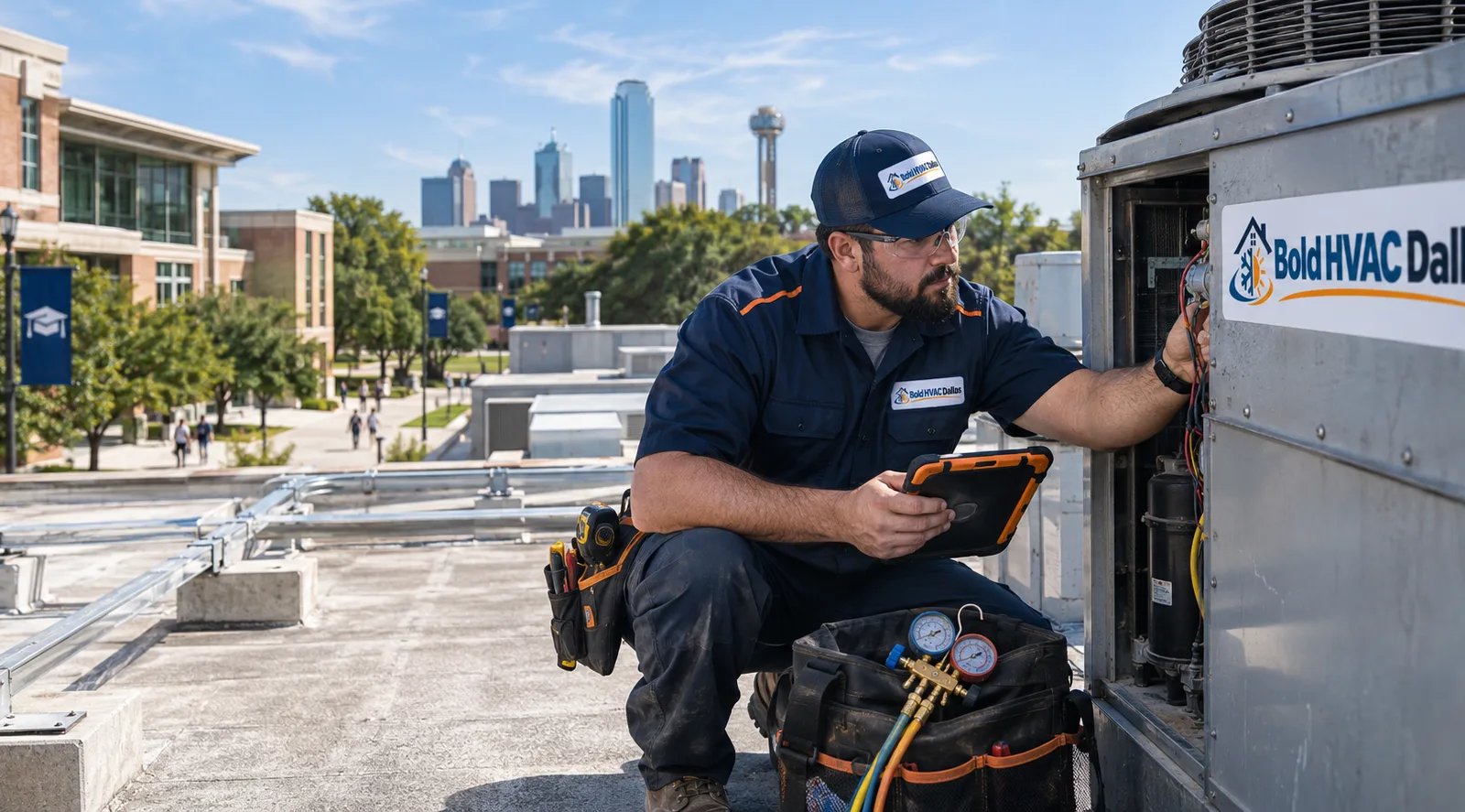
HVAC technician inspecting rooftop commercial air-conditioning equipment on an active Dallas college campus

Heating and Cooling Support for College Facilities

Searching for HVAC Dallas College services often means a comfort problem is already affecting classes, staff, equipment, or scheduled activities. Bold HVAC Dallas handles HVAC diagnosis, repair, replacement, and preventive maintenance for educational and commercial spaces. The work begins with the equipment, controls, airflow, and operating conditions rather than assumptions based on a single symptom.

As an HVAC service team in the Dallas area, we work to identify the source of the problem, explain practical options, and define the scope before repairs or replacement begin. That matters in college buildings, where one property may contain lecture rooms with changing occupancy, computer spaces with steady heat loads, offices with different schedules, and large common areas served by separate zones.

Dallas cooling systems face long periods of high demand during hot weather. Heating equipment may run less often, but a fault can become apparent as soon as cold conditions arrive. Planned inspection before seasonal demand helps uncover dirty coils, weak capacitors, worn contactors, blocked condensate drains, damaged wiring, control faults, and restricted filters before they cause avoidable interruptions.
Complete facility support

HVAC Dallas College Service Capabilities

Troubleshooting and Repair

Diagnosis covers the reported symptom and the system conditions behind it. Technicians may check thermostat calls, electrical components, refrigerant circuit readings, blower operation, supply and return temperatures, airflow, safeties, and control signals before recommending a repair.

Equipment Replacement

Replacement planning considers building load, existing ductwork, electrical service, ventilation needs, controls, equipment access, and the condition of related components. Correct sizing matters because oversized and undersized systems can both create comfort and operating problems.

Preventive Maintenance

Maintenance can include filter review, coil inspection, drain clearing, electrical checks, blower and belt inspection where applicable, thermostat testing, and operating-temperature measurements. Findings can be prioritized by urgency rather than treated as a generic checklist.

Airflow and Zoning

Rooms that stay warm or cold may have duct leakage, closed or poorly balanced dampers, inadequate return air, incorrect fan settings, control problems, or load changes. Airflow testing helps distinguish a distribution issue from an equipment-capacity problem.

Indoor Air Quality Components

Ventilation, filtration, humidity behavior, drain condition, and coil cleanliness affect occupied spaces. Recommendations should match the system and building use instead of relying on add-ons that may increase static pressure or require unsupported performance claims.

Controls and Scheduling

Thermostats, sensors, zone controls, and programmed schedules affect comfort and runtime. Control review is especially useful when complaints follow room schedules, occupancy changes, or inconsistent temperature readings.

Facility-specific assessment

A Building-by-Building Approach

College facilities rarely operate like a single-family home. Packaged rooftop units may serve classrooms or offices, split systems may condition smaller spaces, and larger buildings may use more complex air-handling and control arrangements. Equipment location also affects the work. Roof access, ceiling access, occupied-room restrictions, and delivery paths should be understood before a repair or changeout is scheduled.

A useful assessment separates the immediate failure from contributing conditions. A frozen evaporator coil, for example, can result from low airflow, a dirty filter, blower trouble, or a refrigerant-side fault. Replacing refrigerant without finding the cause is not a complete diagnosis. Likewise, repeated condensate overflow may point to a clogged trap or drain, poor slope, biological buildup, or an installation issue.

Documentation is valuable when several people oversee a facility. Model and serial information, observed readings, failed components, recommended corrections, access needs, and shutdown requirements should be recorded clearly. This gives facilities staff a usable basis for approving work and planning around classes or events.

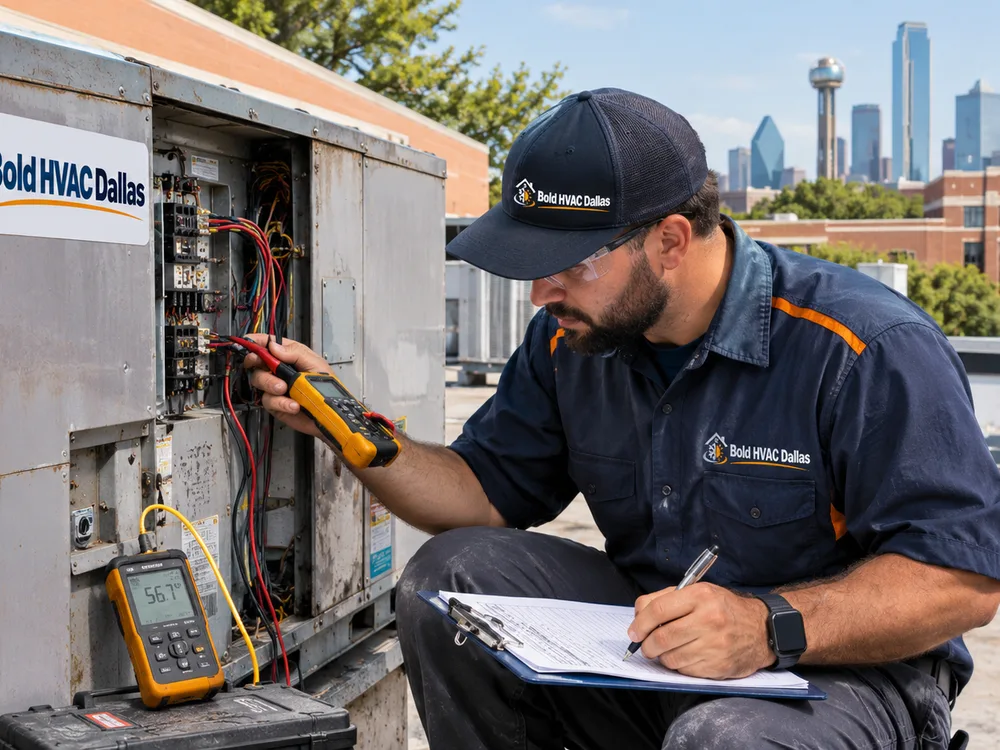
Commercial HVAC technician taking electrical and temperature readings at a packaged rooftop unit
Measurements and written findings support sound repair decisions.
From access to verification

How College HVAC Work Is Planned

Check Availability
01

Confirm the affected area

The process starts with the rooms involved, the timing of the problem, recent equipment behavior, access rules, and any operational limits. Occupancy patterns and prior repairs can narrow the initial investigation.

02

Inspect and test the system

The technician traces the comfort complaint through the thermostat or control, electrical circuit, air side, refrigerant side, drainage, and connected components as applicable. Testing is based on the equipment and symptom.

03

Present findings and scope

The responsible contact receives an explanation of the fault, repair or replacement options, and any related conditions that should be addressed. The proposed scope identifies what is included and what may require additional approval.

04

Coordinate the work

Service is planned around equipment access, occupied areas, shutdown windows, roof procedures, and material availability. If a repair requires specialty parts, the expected next step should be established before the technician leaves.

05

Verify operation

After approved work, the system is started and checked under available conditions. Verification may include temperature split, electrical readings, drain operation, airflow observations, control response, and confirmation that the affected zone is operating properly.

North Texas operating conditions

Dallas Conditions That Affect HVAC Decisions

North Texas heat places sustained demand on cooling equipment, particularly on exposed roofs where packaged units operate in direct sun. Coil condition, condenser airflow, electrical connections, and controls deserve attention before peak demand. Cottonwood and other airborne debris can also obstruct outdoor coils, so cleaning decisions should be based on inspection rather than a fixed assumption.

Dallas County is within the Electric Reliability Council of Texas power region. Power interruptions and voltage disturbances can expose damaged contactors, fuses, capacitors, disconnects, or control boards, although testing is needed before attributing a failure to an electrical event. Surge protection may be considered for compatible equipment, but it does not replace proper grounding, overcurrent protection, or routine electrical inspection.

Building context matters too. Downtown Dallas properties may have constrained loading, roof access, and service staging. Deep Ellum includes converted and mixed-use buildings where duct routes and equipment access can differ from newer construction. The Cedars combines institutional, commercial, and residential uses, making operating schedules an important part of diagnosis. In University Park, established buildings may have additions or equipment from different installation periods. Richardson has office and educational properties with multi-zone demands. These conditions change access and planning, not the need for measured diagnosis.

Pricing guidance

How Much Do HVAC Dallas College Services Cost?

Commercial HVAC service in Dallas typically starts around $150 to $350 for diagnosis, while common repairs often range from $300 to $2,500. Major component work or packaged-unit replacement may range from several thousand dollars to well over $20,000 per unit. These are general, nonbinding ranges.

Equipment type, tonnage, part availability, refrigerant, roof or ceiling access, crane needs, controls, ductwork, permits, and required working hours affect the final price. Multi-unit projects are priced by verified scope. The exact cost is confirmed after an on-site inspection and equipment assessment.

Check Availability
Condition-based planning

Repair, Replace, or Plan a Phased Upgrade?

Repair is often reasonable when the fault is isolated, suitable parts are available, and the rest of the system is in serviceable condition. Replacement deserves consideration when failures are recurring, a major component has failed, controls are obsolete, refrigerant or parts are difficult to source, or the equipment no longer supports the building's load and ventilation needs.

Age alone should not decide the issue. A useful comparison includes the verified repair, the condition of the compressor and heat exchangers where applicable, coil condition, cabinet corrosion, electrical wear, service history, duct and airflow limitations, and compatibility with existing controls. If replacement is recommended, load calculations and field conditions should guide capacity. Matching the old nameplate without reviewing changes in occupancy, lighting, equipment, windows, or room use can repeat an existing sizing problem.

Campuses with several aging units may benefit from phased planning. Equipment condition, area priority, failure risk, access complexity, and budget timing can be used to rank projects. This approach lets decision-makers address immediate comfort needs while preparing for larger capital work.

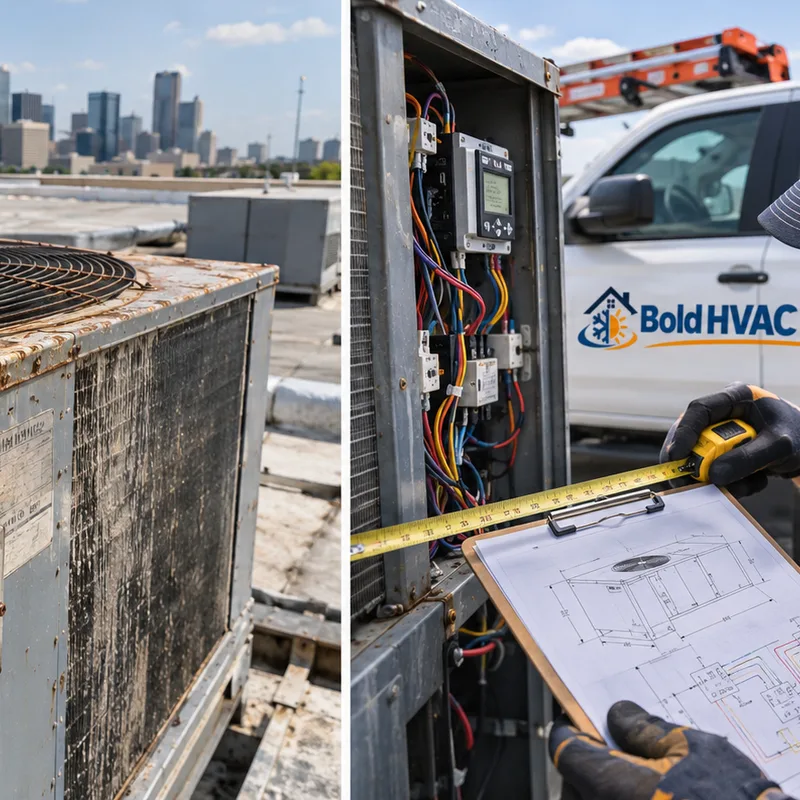
Aging commercial rooftop HVAC unit and technician reviewing replacement measurements and controls
Repair and replacement decisions should be based on condition, load, access, and long-term serviceability.

Bring the equipment history, affected-room details, access requirements, and scheduling limits to the first conversation so the inspection can focus on the right systems and produce a clear scope.

Call to Schedule
Helpful answers

Questions About HVAC Service for Dallas Colleges

How quickly can a Dallas college HVAC problem be assessed?+

Assessment timing depends on technician availability, campus access, equipment location, and the severity of the issue. A precise diagnosis may be possible during the initial visit when the unit is accessible and operating under the problem condition. Rooftop access procedures, locked mechanical rooms, specialty controls, or intermittent faults can require coordination or follow-up testing.

Can HVAC work be scheduled around classes and campus events?+

Yes, work can often be planned around occupancy, quiet periods, and approved shutdown windows. The facilities contact should identify restricted rooms, roof-access requirements, event schedules, and areas where noise or temporary temperature changes would be disruptive. Some testing must occur while equipment and affected zones are operating.

What information helps with an HVAC service request?+

Provide the building and room numbers, equipment identification if available, when the problem began, thermostat behavior, unusual sounds or odors, recent work, and whether breakers or controls were reset. Dallas heat can make intermittent cooling faults load-dependent, so noting the time and outdoor conditions associated with the complaint can help.

Should an older college HVAC unit be repaired or replaced?+

The choice should be based on verified failure, overall condition, repair history, parts availability, efficiency, control compatibility, and whether the unit still fits the building load. A failed capacitor may justify a focused repair, while compressor failure combined with deteriorated coils, obsolete controls, or repeated service may support replacement.

How long does commercial HVAC replacement take?+

A straightforward packaged-unit replacement may be completed within a working day after equipment and permits are ready, but complex projects can take several days or longer. Crane scheduling, curbs or adapters, electrical changes, duct transitions, controls, roof access, inspections, and campus shutdown rules all affect the schedule.

Can one maintenance plan cover different HVAC systems on a campus?+

A coordinated plan can cover different equipment, but each unit should have tasks and intervals suited to its design, condition, environment, and operating schedule. Filter needs, belts, drains, coils, heat exchangers, controls, economizers, and refrigerant circuits do not all require identical work. An equipment inventory is the practical starting point.

Are permits required for college HVAC replacement in Dallas?+

Many equipment replacements and system alterations require permits and inspections under the authority having jurisdiction. Requirements depend on the property, equipment, electrical or gas work, and project scope. For work within the City of Dallas, the proposed scope should be checked against current city requirements before installation begins.

Plan the next step

Plan the Next HVAC Service With Clear Information

Tell Bold HVAC Dallas which spaces are affected, what the system is doing, and how the building operates. The next step is a focused assessment, documented findings, and a practical scope for repair, maintenance, or replacement.